Two Weeks Parked: Why Your Rear Brakes Might Refuse to Let Go
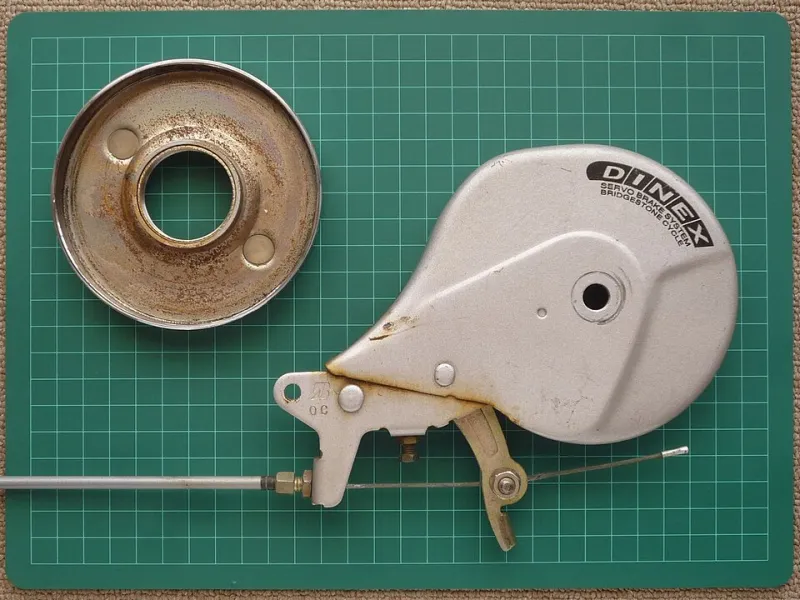
Photo: imoni, CC BY-SA 3.0, via Wikimedia Commons
Every January we get the same phone call. Someone has come back from a week in Lanzarote, gone to move the car off the driveway, and heard a noise like a wheelie bin being hit by a bus. The car either rolls two feet and stops dead, or it moves but drags a rear wheel like it's towing a trailer. Nine times out of ten, the handbrake has been on since the day they left. Nobody did anything wrong, really. They just parked the way they always park.
What's actually happening back there
On a lot of cars, the rear brakes do double duty. The foot brake works the pads or shoes, and the handbrake works a separate set of shoes inside a small drum — often built into the back of the rear disc. On others, especially smaller hatchbacks, you've got plain old drum brakes at the back and the handbrake just pulls the shoes out against the drum.
Either way, when you park with the handbrake on, those friction surfaces are pressed tightly together. Add a bit of moisture and you've created a tiny, warm, damp sandwich of steel and brake lining. Leave it for two weeks and the rust film that forms doesn't just sit there. It grows into the lining. Sometimes it's a light bond that breaks with a bang. Sometimes it's a proper seizure, and no amount of revs will shift it.
Why a British fortnight is worse than a fortnight abroad
It's the damp. A car parked in a cold, wet UK driveway is effectively sitting in a slow-motion humidor. Overnight condensation forms on the brake surfaces, then dries a bit in the day, then forms again. Every cycle gives the corrosion a little more grip. If you drove through a puddle or gave the car a wash before you left, you've basically primed the surfaces for it.
Cold makes it worse too. Brake linings and the metal they sit against contract at slightly different rates, and a hard frost can leave the handbrake mechanism itself stiff — cables, levers and pivots that were fine in October suddenly aren't keen on moving in February. That's before we get to road salt, which loves nothing more than a bit of bare steel to nibble on.
The airport car park trap
Long-stay parking is the classic scenario. You arrive at some ungodly hour, park in a marked bay, yank the handbrake up hard because that's what you've always done, and get on a plane. Fourteen days later, the car has been sitting in whatever the weather threw at it and the rear brakes have had a lovely time.
If the car has an electric parking brake, it's easy to forget it's even on — the switch does the work and the car holds itself. Many electric systems will release automatically when you pull away, which is a help, but not if the shoes have already rusted to the drum. And on a slope, you do need something holding the car. That's where a bit of forward planning comes in.
Before you fly: a five-minute routine
On flat ground, the safest way to leave a car for a fortnight is with the handbrake off. Leave it in first gear, or in Park if it's an automatic, and chock a wheel if you're at all nervous. On a slope, you can't do that, so use the handbrake but don't haul it up to the last notch — firm is enough. If you've got an electric parking brake and the car is on level ground, check the handbook; many will let you leave it off with the transmission holding the car.
Don't wash the car the night before you go. A quick run to dry the brakes afterwards is better than leaving them soaked. And if you've driven through standing water on the way to the airport, a few gentle stops from speed on the approach will warm the brakes and drive off the worst of the moisture before you park.
What you'll notice when you get back
A single loud crack as you pull away is often just the rust bond breaking. That's not ideal, but it's not a disaster. What you want to watch for is a wheel that drags, a burning smell after a short drive, or a rear wheel that's noticeably hotter than the other side. Grinding, a pulsing pedal or a handbrake that now comes up much higher than it used to all point to something that needs looking at properly. If the car feels like it's being held back, stop. Dragging a seized brake down the A1 will cook the disc, the wheel bearing and possibly the tyre.
If the rear wheels have locked up
Don't sit there revving it and dumping the clutch. You'll either break something expensive or launch the car into the garage door. Try rocking it gently — first gear, ease forward, ease back, repeat — and see if the bond lets go. If it's an electric parking brake, make sure it's actually releasing; the motor can be fine but the shoes still stuck. Beyond that, it's a recovery job. A garage can free a stuck brake with the right tools in minutes, whereas forcing it can turn a simple strip-and-clean into new drums, shoes and fitting kit.
The honest garage view
Most of the time, a seized rear brake is a cleaning job. We strip it, free the lever and pivots, clean up the drum, check the lining and cable, and put it back together. If the lining has torn off or the drum is scored, it turns into parts. Either way, it's a lot cheaper than the recovery truck plus the missed ferry. The real fix, though, is not giving it two weeks to happen in the first place — handbrake off on flat ground, in gear, wheels chocked, and a dry run before you park. Your rear brakes will thank you.