The Sidewall Secret: Why a Five-Year-Old Tyre Can Fail on Perfect Tread
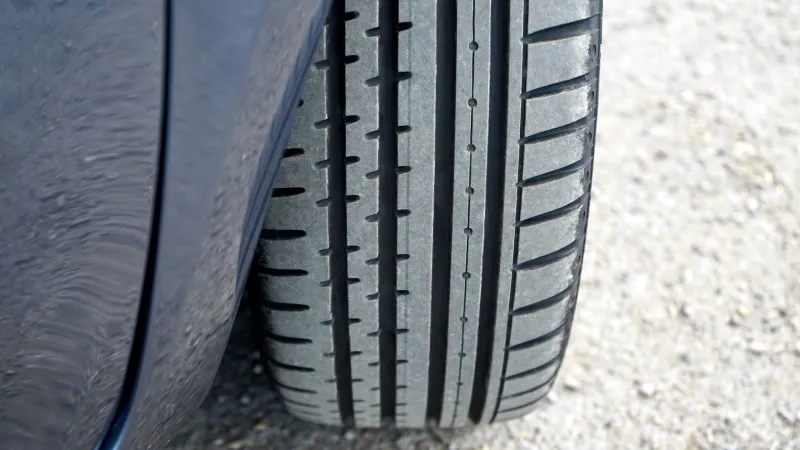
Most drivers know the 1.6mm tread law. It's in the Highway Code, it's on the MOT sheet, and it's the number every tyre fitter quotes at you over the counter. But tread depth only tells half the story. The other half is moulded into the sidewall in characters about the size of a grain of rice, and it's the bit almost nobody checks until something goes wrong.
The number that doesn't appear in your service book
Since the early 2000s, every tyre sold in the UK has carried a DOT code — short for Department of Transportation, a leftover from the American system that became a global standard. It's a string of letters and numbers, and the last four digits are the ones that matter. They tell you the week and the year the tyre was made.
Read it as two pairs. A code ending 3421 means week 34 of 2021. A code ending 0819 means week eight of 2019. Older tyres may have only three digits, where the first two are the week and the last is the year within the 1990s — if you find one of those on your car, you've got bigger problems than a date code.
Where to look without jacking the car up
The DOT stamp isn't always on the outside face of the tyre. Manufacturers often mould it on one sidewall only, which means the tyre on the offside rear might have its code facing inwards. You can usually find it by turning the front wheels onto full lock and peering behind the wheel arch. For the rears, a phone camera on the end of your arm works wonders, or a quick slide underneath with a torch.
Give the sidewall a wipe first. Years of road grime and tyre shine can make the code almost invisible. Look for the letters DOT, then a block of up to twelve characters — the final four are your date.
Why age beats mileage
Rubber isn't a inert material. It's a carefully blended compound of polymers, oils, and antioxidants designed to flex and grip. Those oils migrate through the rubber as the tyre is used, keeping it supple. A car that sits on a driveway for months at a time doesn't give its tyres that workout, and the rubber slowly hardens.
That's why a low-mileage car can be a minefield. A second car, a motorhome, a classic that only comes out in summer — they're all candidates for tyres with 4mm of tread and eight years of age. The tread looks fine in a photograph. The rubber underneath may be brittle, cracked, and well past its best.
There's no legal expiry date on tyres in the UK, and the MOT won't fail a tyre purely because it's old. But the industry consensus is clear: from about five years, tyres should be inspected annually for signs of ageing, and at ten years they should be replaced regardless of tread depth. Some manufacturers suggest a shorter window for caravans and trailers, which often sit idle for long stretches.
What British weather does to old rubber
UV light is the quiet enemy. It attacks the sidewall, breaking down the chemical bonds that keep the rubber flexible. A car parked facing the sun every day will show sidewall crazing years before a garage-kept one. Add ozone — the faint electrical smell you get near busy junctions — and you get tiny surface cracks that spread into deeper fissures.
Winter makes it worse. Cold rubber is naturally stiffer, and old rubber is stiffer still. Combine that with wet roads and the occasional frost, and you've got a tyre that can crack at the shoulder or fail under braking when you need it most. Standing water is the other issue: a tyre that's been sitting in a puddle for weeks can take on moisture through microscopic cracks, weakening the internal cords.
And then there are the bulges. A bulge in the sidewall means the internal structure has been damaged — usually by a pothole or a kerb. That's not an age issue, it's an immediate replacement. Don't drive on it, don't pump it up, don't wait for payday.
The spare in the boot is still a tyre
Here's the one that catches people out. The spare wheel has probably been in the boot since the car was built. It's never touched the road, never worn a millimetre of tread, and looks brand new. It could still be twelve years old.
Space savers are particularly guilty. They sit under the boot floor with a warning sticker about 50mph and 50 miles, and most drivers only remember they exist when they get a puncture. Check the date code on the spare the same way you check the road tyres. If it's older than ten years, replace it — a failed spare is no spare at all.
While you're in there, check the pressure. Spare tyres are often inflated to a much higher figure than the road tyres — 60psi is common for a space saver. The correct figure is usually printed on the tyre itself or in the handbook. A soft spare is almost as useless as an old one.
When to replace, and how not to get caught out
If any tyre on your car is showing cracks in the tread grooves, sidewall crazing, or a date code older than ten years, book it in. Replace in pairs on the same axle where possible, and always match the load and speed rating to the original specification.
Be wary of part-worn tyres. A bargain tyre with 5mm of tread is no bargain if the date code says 2018. Ask to see the code before you hand over any money. A reputable fitter won't mind showing you.
A five-minute check before the cold arrives
Before the first proper frost, do this: find the date code on all four tyres and the spare, write the dates down, and check each sidewall for cracks or bulges. Check the pressures when the tyres are cold, and check the tread depth — 1.6mm is the legal limit, but wet grip drops off noticeably below 3mm.
It's not the most glamorous job on the driveway. But a five-minute crawl around the car now could save you a very unpleasant conversation with a tyre fitter in January — or worse, a moment on a wet roundabout when the rubber that looked fine in the showroom decides it's had enough.