Pulsing Pedal, Healthy Discs: The Brake Judder Diagnosis Most Garages Skip
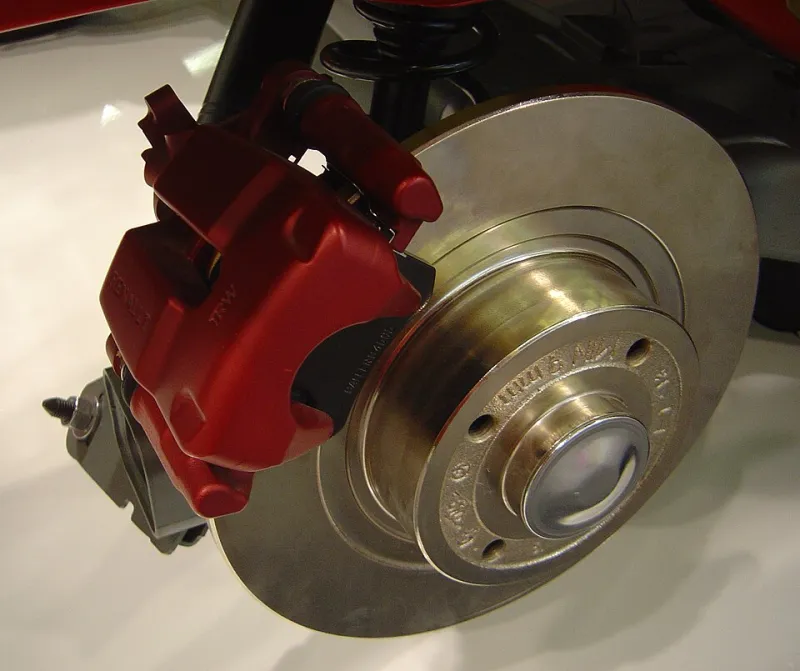
Photo: Unknown, CC BY-SA 3.0, via Wikimedia Commons
There's a particular kind of shudder that shows up on a Monday morning commute, usually on a dual carriageway slip road, and it has a way of making drivers reach straight for the phrase 'warped discs'. It's an easy conclusion to jump to. The pedal pulses, the steering wheel nibbles, the whole car feels like it's braking over a rumble strip. Book it in, get a quote for discs and pads, job done.
Except it often isn't. In plenty of the cars that come through the workshop with this complaint, the discs are flat, within thickness tolerance, and not remotely bent. Replacing them without understanding what's actually going on is the motoring equivalent of changing a fuse without checking why it blew.
Cast Iron Doesn't Warp Like a Fruit Bowl
The first thing worth saying is that a brake disc is a lump of cast iron, and cast iron is remarkably stubborn. It gets hot — properly hot, several hundred degrees on a hard stop — and it expands and contracts, but it doesn't tend to twist into a Pringle shape just because you braked late for a roundabout.
What does happen is that the disc develops variations in thickness, often called DTV, or disc thickness variation. A disc that's, say, 0.03mm thinner in one spot than another doesn't sound like much. But at speed, that tiny difference translates into a pulsing piston, a pulsing pedal, and a pulsing wheel. The driver feels judder. The garage says 'warped'. The real story is usually deposits or corrosion, not metallurgy.
The Pad Deposit Problem Nobody Mentions
Brake pads don't just wear away — they leave a transfer layer on the disc face, a thin film of friction material that helps the pad bite consistently. Under normal use that layer stays even. Under the wrong conditions, it doesn't.
Think about the typical British driving pattern: a fast A-road run, a few hard stops, then the car sits for two days. The pads stay clamped against hot discs, and a small patch of friction material cooks onto the surface. Repeat that over a few months and you get high spots — raised areas of deposited material that the pad grabs harder than the rest of the disc. The disc itself hasn't bent. The surface has just stopped being uniform.
This is why the judder often appears after a period of light use, or after the car has been parked up over a damp weekend. It's also why some drivers notice it's worse when the brakes are warm and less noticeable when they're cold.
Corrosion Is the Quiet Co-Conspirator
The UK's climate is a brake disc's least favourite thing. Salt, rain, and long periods of inactivity mean a film of surface rust forms on the exposed face of the disc within days. Most of it scrubs off on the first few stops. But on a car that's used infrequently, or one that does a lot of short trips where the brakes never get properly warm, that rust can settle in and start eating into the surface unevenly.
The result is a disc that looks fine on a quick glance through the alloy spokes but has a patchy, pitted face that produces exactly the pulsing pedal the driver blames on warping. Again: new discs are not necessarily the answer. Cleaning up the surface — or in some cases a light skim — can be enough, provided there's thickness to play with.
The Other Suspects Worth Ruling Out
Before anyone starts ordering parts, a decent diagnosis should cover the rest of the braking system too. Judder can come from:
- A sticking caliper slide pin or piston, which keeps one pad in light contact and cooks deposits onto one side of the disc.
- Contaminated hub faces. Dirt, rust, or a stray flake of old threadlocker between the disc and the hub can tilt the disc by a few thousandths of a millimetre — enough to feel through the pedal.
- Uneven wheel nut torque, especially on alloys, which can distort the disc mounting face.
- Worn suspension bushes or a tired wheel bearing, which let the whole assembly move under braking load and mimic a brake fault.
- Rear brakes, which often get misdiagnosed as front. Judder through the seat rather than the steering wheel is a clue.
A good garage will feel the judder on a road test, then measure. That means a dial gauge on the disc to check lateral runout, a micrometer at several points to check thickness variation, and a proper look at the pad wear pattern. If the discs come off, the hub face gets cleaned before anything new goes on. That last step is skipped more often than you'd think, and it's the reason some drivers get judder back within a few thousand miles of a disc and pad change.
Why the Cheap Fix Often Costs More
There are two shortcuts worth avoiding. The first is fitting new pads onto old, contaminated discs. The pads can't bed in properly against a surface that's already uneven, and the judder returns almost immediately — usually with a slightly different character. The second is skimming discs without checking thickness. A skim removes material, and a disc that's already near its minimum thickness is not a candidate.
The other false economy is buying the cheapest discs available and expecting them to behave like OEM parts. Budget discs can arrive with runout out of the box, or with a hub face that isn't machined cleanly. On a car that's sensitive to small variations, that's a gamble.
When New Discs Genuinely Are the Answer
None of this is an argument against replacing discs. Sometimes they really are finished: deep scoring, a pronounced lip on the outer edge, blue heat spots, or cracks around the cooling holes. If the thickness is at or below the minimum stamped on the disc, or the runout is out of specification even after the hub has been cleaned, new discs are the sensible call. The point is that the decision should be based on measurement, not on the word 'warped' appearing on a job sheet.
The Bedding-In Bit Drivers Skip
If you do end up with new discs and pads, the first few hundred miles matter more than most people realise. The aim is to transfer an even layer of pad material onto the disc face. That means a series of moderate-to-firm stops from around 50-60mph, spaced out to let things cool, followed by a gentle period of normal driving. What you don't want is a single hard emergency stop followed by parking the car with hot pads clamped to hot discs — the classic recipe for the judder you just paid to fix.
What to Ask at the Counter
If you're booking a car in for a brake judder, it's fair to ask two questions. First: will you measure runout and disc thickness before quoting? Second: if the discs are being replaced, will the hub faces be cleaned and the wheel nuts torqued properly? Neither question is unreasonable, and the answers tell you a lot about how the job will be done.
A pulsing pedal is a symptom, not a diagnosis. Treating it as one is the difference between a brake job that lasts and a comeback in three months.