Your Coolant Doesn't Care About Colour: The Chemistry That Decides Whether Your Heater Survives Winter
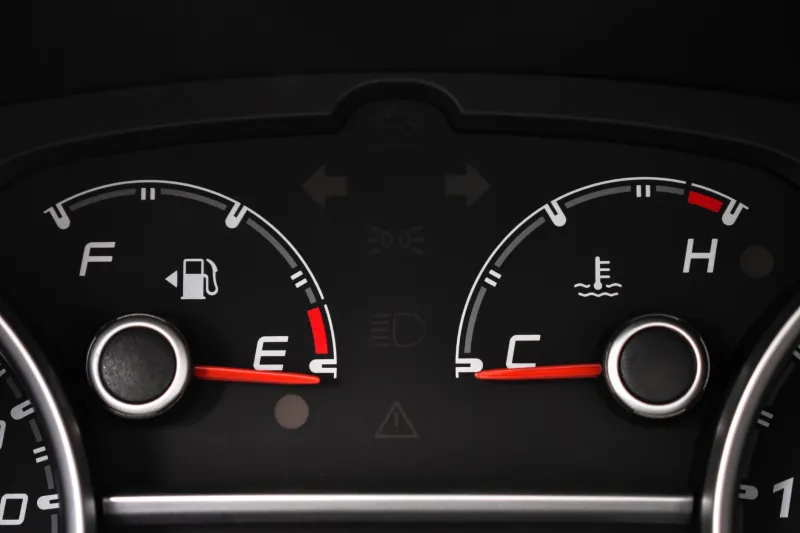
There's a particular kind of optimism that grips people in a motorway services car park in November. The coolant light has flickered on somewhere near junction 12, the bonnet is still warm, and there's a bottle of bright pink fluid on the shelf with a picture of a radiator on it. It looks like the same colour as what's in the car. It goes in. Job done.
Nine times out of ten nothing dramatic happens immediately. That's the trouble. Coolant chemistry doesn't fail like a bulb — it fails quietly, over a winter, in the heater matrix and the water pump seals and the narrow channels around cylinder four. By the time you notice, you're not buying antifreeze. You're buying labour.
Colour Is a Label, Not a Specification
The single most common piece of coolant advice — "just match the colour" — is also the most misleading. There is no British Standard, no EU directive, and no industry-wide agreement that says pink means one thing and green means another. What you get is a patchwork of manufacturer conventions. VW Group's pinkish G12 family is not the same chemistry as Toyota's pink, which is not the same as the orange-red you'll find in some Vauxhalls, which is not the same as the long-life blue some specialists sell. Two bottles can look identical in the shop and behave completely differently in your engine.
What actually matters is the corrosion inhibitor package. Broadly, you're dealing with two families:
- IAT (inorganic acid technology) — the older silicate, borate and phosphate-based formulas. Usually green or blue, fast-acting, and brilliant at protecting cast iron and brass. The catch is that silicates don't last. They drop out of suspension over time and form a gel or a gritty deposit.
- OAT (organic acid technology) — the newer carboxylate-based formulas, typically pink, red or orange. Longer service life (often five years or more), gentler on aluminium, and the default for most cars built in the last fifteen years. Some are 'hybrid' (HOAT) or 'lobrid' blends that add a little silicate back in for specific metallurgy.
Mix the two and you don't get a super-coolant. You get exactly the problem the silicates were meant to solve: precipitation. In plain English, the inhibitor falls out of solution and turns into sludge.
Where the Sludge Ends Up
That sludge doesn't sit politely at the bottom of the expansion bottle. It travels. It settles in the thinnest passages it can find — which in a modern car means the heater matrix, a maze of tiny aluminium tubes behind the dashboard, and the narrow coolant galleries around the cylinders.
A blocked heater matrix shows up as a car that blows lukewarm air on the driver's side and cold air on the passenger side, or a demist function that stops demisting in exactly the weather you need it. A partially blocked gallery shows up as uneven cylinder temperatures and, eventually, a head gasket that gives up between two cylinders. And the water pump? Its seal relies on the coolant's lubricity; contaminated coolant wears it out and you get the classic drip from the weep hole, followed by a snapped belt if you're unlucky.
None of this is exotic. It's a quiet, cumulative failure, and it's the reason a £9 bottle at a filling station can contribute to a bill with four digits on it.
Doing It Properly on a Cold Morning
First, and non-negotiable: the engine must be cold. Not 'warm but I'm in a hurry'. Opening a pressurised cooling system at 90°C sends scalding coolant into the air, and you will not enjoy it. Leave it overnight if you can.
Then work through this in order:
- Find the actual specification. It's in the owner's manual, usually in a table of fluids and capacities, and it's often printed on the expansion bottle cap. Look for a manufacturer standard — VW G12++/G13, Ford WSS-M97B44-D, GM 6277M, JIS K2234, or whatever your car's maker uses. That code, not the colour, is the answer.
- Check the level against the MIN and MAX marks with the car on level ground. If it's only slightly below MIN, you may not need to add anything at all — coolant expands and contracts with temperature, and a reading taken hot will lie to you.
- Top up with the correct ready-mixed coolant, ideally the same brand the system already has. If you can't establish what's in there, buy a proper flush and refill kit or book it in. Guessing is exactly the habit this article is warning you about.
- Don't overfill. Above MAX, the system has nowhere to expand into and will dump the excess out of the overflow — which is how people end up chasing a 'leak' that was actually a top-up.
- Find out why it was low. Coolant doesn't evaporate from a sealed system at any meaningful rate. A slow loss means a weeping hose, a failing water pump, a porous radiator or a head gasket that's starting to pass. Topping up and forgetting is just delaying the diagnosis.
When Plain Water Is Acceptable
If you're stranded, the heater matrix is blowing cold and there's steam, then yes — water from a tap will get you home. It dilutes the antifreeze concentration, raises the freezing point, and drops the corrosion protection, so treat it as a temporary measure measured in miles, not weeks. Distilled or deionised water is kinder to the system than hard tap water, which leaves limescale behind, but if the choice is a hard-water tap or an overheating engine, take the tap every time.
Once you're home, drain and refill with the correct mix — usually 50/50 coolant and water, though some modern formulas are sold pre-diluted and shouldn't be watered down further. A glycol refractometer costs less than an hour's labour at most garages and lets you check the concentration in about thirty seconds, which is genuinely useful in a Scottish January when you're not sure what the last owner did.
The Winter Test
Antifreeze isn't just about freezing. It raises the boiling point, which gives you margin on a hot day, and it carries the corrosion inhibitors that keep the whole system alive. A weak mix doesn't announce itself. It just quietly lets the heater matrix corrode and the head gasket edge towards failure.
So next time the level drops, resist the urge to grab whatever's on the shelf because the colour looks right. Read the spec, buy the right stuff, and take five minutes on a cold engine. Your heater will thank you in February, and your wallet will thank you for a lot longer than that.